Before
✳Project snapshot
A quick read on the people, platform, and practical constraints behind the work.
Role
Product DesignerProduct Builder
Platform
WordPressElementor Pro
Scope
Discovery through implementation
Status
In development on staging
01At a glance
After
A guided story and a more useful publication-discovery model.
Bridge
Research, structure, validation, and a content model built for the CMS.
02Before
A substantial body of research, but no clear path through it.
INSPECT-LB is an autonomous, multi-university and multidisciplinary research organization focused on health, professional practice, and education in Lebanon. Its site reports more than 800 publications, alongside research themes, tools, datasets, expertise, and partnerships.
The challenge was not a lack of content. The homepage did not yet guide visitors through a clear sequence: what INSPECT-LB is, why its work matters, where its expertise sits, and what someone should do next.
The connected problem
Publications were available, but discovery was limited.
Category links led into long publication lists. For a large and multidisciplinary archive, discovery needed to work as more than a directory—it needed to connect broad interests to relevant evidence.
Q1
How might the site present INSPECT-LB as a trusted national reference, not only as a producer of research?
Q2
How might scientific output become easier to browse and connect to themes, expertise, resources, and engagement?
The scale behind the brief
800+
publications reported on the site
22
community discovery responses
3
internal prototype evaluators
03After
A clearer institutional story—and a system for finding evidence.
I reframed the homepage as a deliberate sequence rather than a collection of independent sections: positioning, impact, organizational context, partnerships, publications, research themes, and collaboration.
Each section now answers a visitor question and builds toward the next: Who is INSPECT-LB? Why is its work credible? What does it research? What evidence can I explore? How can I engage?
01
Discovery
Institutional story and audience needs
02
Structure
Information architecture and content pathways
03
Prototype
Homepage narrative and publication discovery
04
Build
WordPress implementation on staging
01
Guided narrative
Institutional identity leads into evidence, research themes, resources, and meaningful next steps.
02
Progressive IA
Clearer routes help different audiences understand the organization, explore research, and access tools.
03
Faceted discovery
Research theme, method, SDG, topic, country, and year become structured ways into the same archive.
04Information architecture
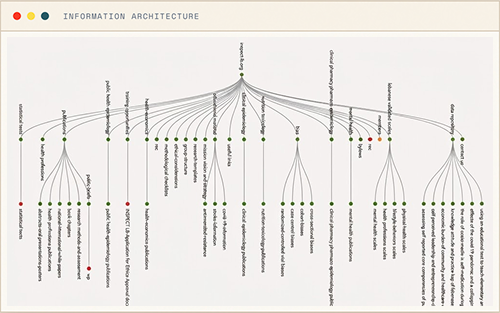
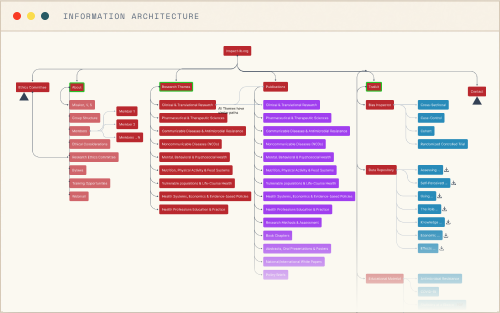
From differently structured branches to clearer pathways.
I reorganized the proposed sitemap around progressive navigation, renamed unclear legacy pages, and added dedicated entry points for research themes.
The value was not a new menu by itself, but a clearer model of how identity, research, publications, tools, people, and engagement relate.
05Publication discovery
Several ways into one structured archive.
A policymaker might begin with a topic or country. A researcher might start with a method, year, or theme. Each route leads into the same publication system rather than a separate content silo.
publication discovery prototype
Title / DOI
Research theme
Method / country
06Bridge
The work between “redesign the site” and a buildable product system.
Discovery changed the brief from a visual redesign into a clearer role for the platform. I used a twelve-question survey to understand future positioning, audiences, credibility, content priorities, and desired behaviors.
Twenty-two community members responded. I synthesized recurring themes rather than treating individual preferences as requirements.
What discovery changed
Not simply a research producer. A trusted reference and gateway to action.
A trusted national reference
A gateway to collaboration
A knowledge hub, not a static archive
Policymakers as the clearest strategic audience
Evidence boundary: the archive contains the documented themes, but not anonymized raw responses. No percentages, response counts by theme, or participant quotes are claimed here.
01
Discover
Survey + synthesis
02
Frame
Audience + role
03
Structure
Narrative + IA
04
Prototype
Wireframe to hi-fi
05
Validate
Scenario walkthroughs
06
Build
WordPress staging
07Iteration
Structure first. Fidelity second.
Wireframes focused on hierarchy and sequence. The long-form low-fidelity prototype allowed the whole page story to be reviewed as one experience. High fidelity then translated those decisions into a coherent visual system.
homepage wireframes
01
02
03
high-fidelity homepage design
inspect-lb
08The knowledge platform
The interface and the content model were designed together.
Every publication filter depends on consistent fields, controlled taxonomies, and realistic content-entry behavior. I separated single-value metadata—theme, year, type, title, DOI—from multi-value taxonomies such as methods, topics, SDGs, countries, and authors.
This made the filter behavior explicit and created a clearer foundation for managing the system inside WordPress. Bulk import is planned, not complete.
Internal validation
All three stakeholders reached the content they were looking for.
Two co-founders and a technical focal point tested four scenario areas: understanding INSPECT-LB, exploring research, finding publications, and moving between related content. Their hesitation around labels, pathways, homepage prioritization, and publication entry points led to targeted refinements.
This was qualitative internal-stakeholder validation—not a statistically significant external-user study or a usability success rate.
09Current outcome
A strategic direction that is now moving into implementation.
The project has produced a redesigned information architecture, a high-fidelity homepage, a publication-discovery concept, and a supporting publication data model. The direction is now being implemented in WordPress.
Staging—not launched
No post-launch impact is claimed.
Responsive behavior, bilingual handling, accessibility, performance, plugin configuration, and the editor workflow still require staging evidence.
What I will measure after launch
01
Paths visitors take to reach priority content
02
Engagement with research-theme pages
03
Publication search and filter behavior
04
Movement between related content
05
Efficiency of reaching meaningful next actions
06
How non-technical editors manage publications
What this project demonstrates
Strategy, systems thinking, and ownership from discovery into the CMS.
Strategic reframing of a complex research institution
Multi-audience content strategy and information architecture
Product thinking applied to publication discovery
Systems thinking across interface, taxonomy, data, and CMS constraints
End-to-end ownership from discovery through implementation