✳Project snapshot
A product research platform built around real apps, flows, and screens.
FounderProduct DesignerProduct Builder
Product strategyUX/UI designArabic localisationInformation architectureAI-assisted development
Pre-launchActive development
FigmaWebflowNext.jsSupabaseVercel
Arabic UX research is still unnecessarily difficult.
When designing Arabic digital products, I repeatedly ran into the same problem: finding good references required far more manual research than it should.
Most established UX reference libraries are built around English-language products. Arabic examples are scattered across individual apps, screenshots, competitor research, social posts, and personal reference folders.
Even when a useful screen is found, it often appears without the journey around it. A checkout screen can tell you how one interface looks—but not what happened before it, how the user reached that state, what alternative states exist, or how another Arabic product solves the same problem.
The opportunity
I saw an opportunity to move Arabic product research from a collection of screenshots toward a structured reference system. The product needed to answer a simple question:
“How can a designer quickly understand how real Arabic products solve a specific UX problem?”
The screenshot was not the product. The context around it was.
App
Flow
Screen
Apps
Real digital products
Flows
Complete user journeys
Screens
Steps inside a journey
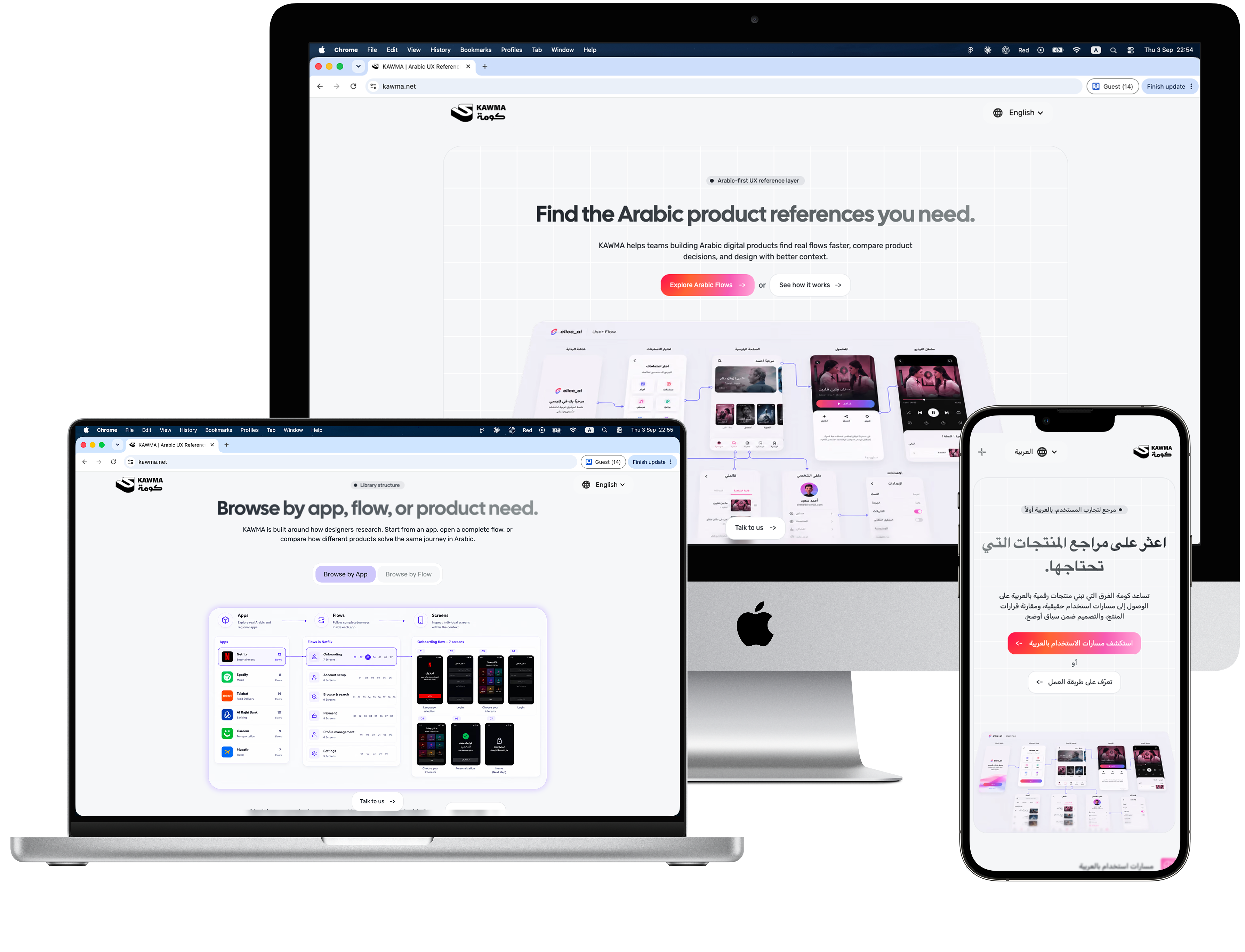
My first major product decision was to stop treating screenshots as independent pieces of content. Instead, I structured KAWMA around the relationships between them.
This structure means someone can discover a useful screen and still understand exactly where it came from. A user can browse an app, select a flow, follow the complete journey, inspect individual screens, and move between related references.
12 apps
4k screens
I designed KAWMA around how product research actually happens.
Research does not always begin in the same place. Sometimes I know the competitor, sometimes the flow, and sometimes only the problem I am trying to solve.
I
Support different paths into the library
Users should not have to understand KAWMA’s internal structure before finding something useful.
II
Never separate a screen from its journey
Screens remain connected to their sequence so a reference is useful at both the interface and interaction-model level.
001
002
003
004
A useful library also had to remain usable as it grew.
The challenge changed once KAWMA moved from a prototype into a library containing thousands of screens. I was no longer designing individual pages. I was designing rules for a system.
The product needed consistent relationships between applications, flows, individual screens, screen order, languages, product categories, interface states, and future tagging.
A flow could not just be a visual gallery. The system had to understand which app the screens belonged to, their sequence, their language, and how they should appear elsewhere in the product.
Reusable components and predictable content structures became more important than designing one-off layouts. That approach created the foundation for future cross-product comparison, richer filtering, and semantic search.
12 apps
4k screens
I did not stop at the prototype.
KAWMA became an opportunity to expand my role from product designer into product builder. After defining the experience in Figma, I began implementing the product using Next.js, Supabase, and Vercel with an AI-assisted development workflow.
Building changed some design decisions: database relationships influenced navigation, content volume influenced component behavior, and real Arabic data exposed edge cases that static prototypes did not.
Define
Design
Build
Test
Refine
Define → Design → Build → Test with real content → Refine
Instead of treating design and development as separate phases, I increasingly worked in a loop.
The core product model has held up as the library has grown.
KAWMA is still approaching public launch, so I do not yet have the retention or conversion metrics I would use to evaluate a mature SaaS product.
The more meaningful validation at this stage is whether the underlying product structure continues to work with real content rather than only inside a prototype.
4,000
product screens
12
real applications
Multiple
complete product flows
Arabic + English
interfaces
12 apps
4k screens
The product direction has been validated at the structural and usability level, while broader market and behavioral validation will come after launch.
The next milestone is expanding the library toward approximately 30 applications before pushing broader adoption.
The hardest part of KAWMA was not designing the interface.
It was deciding what the product needed to understand.
“Good product design is often about defining the system behind the interface before refining the interface itself.”
Moving between research, UX, information architecture, database thinking, interface design, localization, and implementation creates more grounded decisions.
A working foundation for better Arabic product research.
Current state
Problem identified.
System defined.
Product designed.
Product being built and tested with real content.
KAWMA is continuing toward launch as an Arabic-first UX reference platform for designers, developers, and product teams working on Arabic digital experiences.
The immediate focus is expanding the product library, improving discovery, and creating stronger ways to compare patterns and flows across products.